






23.04.2026.
12:32
The second regular session of the spring parliamentary sitting has concluded; laws were adopted
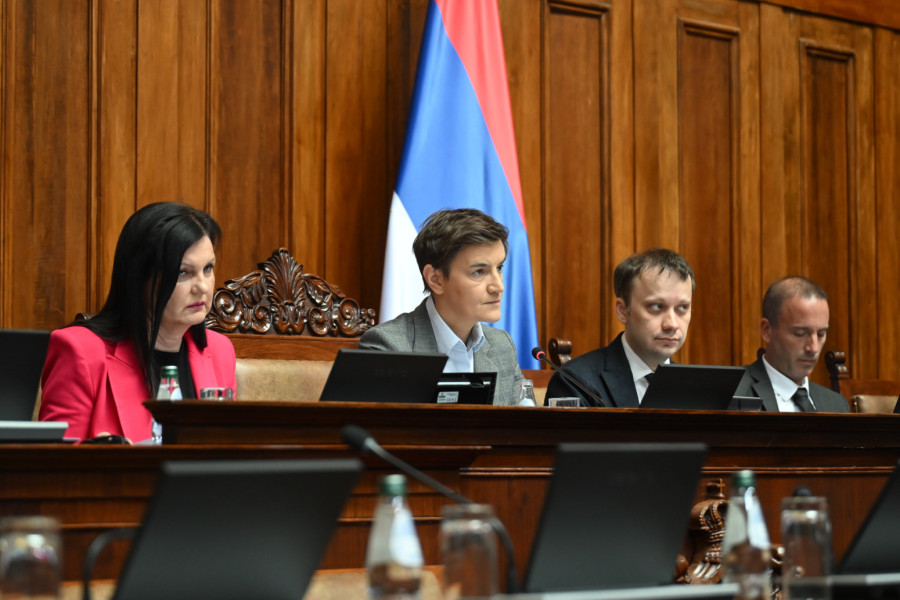
The second regular session of the spring sitting of the National Assembly of Serbia concluded today with a voting day, in which members of parliament voted for all draft laws and confirmed all agreements and decisions on the agenda.



The second regular session of the spring sitting of the National Assembly of Serbia ended today with a voting day, during which members of parliament voted on all draft laws and confirmed all agreements and decisions on the agenda.
The session began on April 16, and the agenda included 40 items.
The National Assembly of Serbia today adopted several laws proposed by the Government of Serbia, including the Law on Consumer Protection, the Law on Amendments to the Law on Trade, and the Law on Trading Practices for Certain Types of Products.
MPs also adopted the Law on the Establishment and Functioning of the Cohesion Policy Management System, the Law on the Prevention and Suppression of Human Trafficking and Protection of Victims, and the Law on Amendments to the Law on Fees for the Use of Public Goods.
The Assembly also adopted the Law on Amendments to the Law on the Transport of Dangerous Goods, the Law on Amendments to the Law on Customs Service, and the Law on the Investigation of Accidents in Air, Rail, and Water Transport.
Members of Parliament also adopted a number of laws confirming intergovernmental and international agreements signed by the Government of Serbia or other state institutions.
Among them were agreements between Serbia and Azerbaijan on the development, design, construction, and management of a combined-cycle gas power plant in Serbia (a gas power plant near Niš); the Convention on the Bureau of the European Civil Aviation Conference; an agreement between Serbia and Japan on the promotion and protection of investments; and an agreement between Serbia and Uzbekistan on mutual promotion and protection of investments.
MPs also confirmed an agreement between Serbia and Russia on cooperation in film co-production; Decision No. 1/2025 of the Partnership, Trade and Cooperation Council between Serbia and the United Kingdom on amendments to Protocol 3 regarding the definition of “originating products” and methods of administrative cooperation under the Partnership, Trade and Cooperation Agreement between Serbia and the United Kingdom of Great Britain and Northern Ireland.
The Assembly also ratified the Financial Protocol between Serbia and France on cooperation in financing Phase 1 of the Belgrade Metro project; the Agreement between Serbia and Cyprus on the status of their forces; and an agreement between Serbia and South Korea on the promotion and protection of investments.
It also confirmed the agreement between the European Union and Serbia on Serbia’s participation in the EU4Health program; an agreement between Serbia and Uzbekistan on cooperation in tourism; and a framework loan agreement (LD 2251, 2025) between the Council of Europe Development Bank and Serbia for public sector financing – rehabilitation of local roads.
MPs also ratified a financial agreement on sustainable improvement of the road network between Serbia and the European Investment Bank; an agreement between Serbia and Cuba on the prevention of illicit trafficking in cultural property; and the Convention on the Establishment of the International Organization for Mediation.
They also adopted laws confirming a loan agreement and financial protocol signed on November 27, 2025, between Serbia and France; a financial protocol on cooperation in financing a high-performance computing (supercomputer) and artificial intelligence development project; and an agreement on mutual recognition of certificates, diplomas, and higher education degrees between Serbia’s Ministry of Education and China’s Ministry of Education.
The Assembly also confirmed a decision on amendments to the decision on the use of the Serbian Armed Forces and other defense forces in multinational operations outside Serbia, as well as four decisions in the field of culture granting protected status to four sites.
The strategy for managing Serbia’s mineral and geological resources until 2040, with projections until 2050, was also adopted.
Several administrative decisions were confirmed, including the election of the president and a member of the Republic Commission for the Protection of Rights in Public Procurement Procedures.
The Law on Consumer Protection was adopted
MPs adopted the Law on Consumer Protection in full, proposed by the Government of Serbia, with 141 votes in favor out of 169 present.
One of the key innovations is that traders will be required to update price lists in real time whenever prices change, ensuring that data always corresponds to actual, current prices in stores and online sales, so that consumers are accurately and promptly informed.
This means retail chains must publish product price lists daily on their websites and on the National Open Data Portal.
The new legal solutions also cover online sales platforms, aligning their obligations with those of traders.
Stronger protection for minors and public health is also provided, as the ban on selling tobacco products to minors is now extended to related products such as electronic heating devices and e-cigarettes.
Amendments to the Law on Trade adopted
MPs also adopted amendments to the Law on Trade in full, proposed by the Government, with 142 votes in favor out of 169 present. Proposed amendments were not accepted.
The law aligns Serbia’s trade regulations with EU consumer protection law, improves trade operations, and introduces a register of purchasing points.
Law on Trading Practices for Certain Products adopted
MPs also adopted the Law on Trading Practices for Certain Products, proposed by the Government, with 142 votes in favor out of 170 present. Amendments were not accepted.
The law regulates internal trade and defines unfair trading practices.
A mechanism of a “cooperator in proceedings,” i.e. a whistleblower, has been introduced.
This is a mechanism that will allow individuals to raise an alarm if there is serious information that unfair trading practices are occurring in a specific case.
The Law on Trading Practices is being adopted for the first time in the Republic of Serbia, and its importance lies in preventing unfair trading practices and establishing fairer, more transparent, and more equitable relations between all market participants—traders, producers/processors, and primary agricultural producers.
The law is largely modeled on solutions already applied in the European Union, but with a significantly broader scope of products and with solutions not present in other European legislation.
Most EU laws cover unfair trading practices only for agricultural and food products, while this Serbian law includes a much broader range of products, thereby helping a larger number of suppliers improve their position relative to traders.
In addition to agricultural and food products, the law also covers products of special importance for market supply, including household chemicals, personal hygiene products, cosmetics, and others, as well as products of special importance for agricultural production such as plant nutrition and protection agents and soil improvers.
The law introduces clear rules and precise definitions of prohibited trading practices considered unfair and placed on a “black list,” as well as those that are conditionally allowed and placed on a “grey list.”
Law on the establishment of the cohesion policy management system adopted
The National Assembly of Serbia also adopted the Law on the Establishment and Functioning of the Cohesion Policy Management System, proposed by the Government, with 141 votes in favor out of 170 present. Amendments were not accepted.
The goal of this law is to establish a system for managing and controlling the implementation of the European Union’s cohesion policy, as well as defining procedures for preparing relevant documents in line with cohesion policy objectives and Serbia’s obligations that must be fulfilled before the completion of EU accession negotiations, so that Serbia will be ready to use cohesion policy funds upon EU accession.
The law regulates the objectives and principles of cohesion policy; funding sources; the strategic framework and preparation of programs financed from cohesion funds; the management and control system; implementation, monitoring, reporting, evaluation, visibility, and public communication; and other issues relevant to the development of the management system.
Cohesion policy is an EU policy aimed at promoting overall and balanced development and strengthening economic, social, and territorial cohesion by reducing disparities between regions and supporting less developed areas.
It is implemented under shared management rules between the European Commission and the Republic of Serbia, which define the use of EU budget funds allocated through cohesion policy.
Law on prevention and suppression of human trafficking and protection of victims adopted
The National Assembly also adopted the Law on Prevention and Suppression of Human Trafficking and Protection of Victims, proposed by the Government, with 142 votes in favor out of 170 present.
The law establishes a National Institutional Mechanism for combating human trafficking and protecting victims, including its structure and responsibilities, and regulates preventive activities, victim rights, identification procedures, and other matters aimed at improving the criminal justice system in this area.
Criminal liability and prosecution of offenders, as well as criminal protection of victims, are regulated by a separate law.
The National Mechanism consists of a Council for Combating Human Trafficking, a National Coordinator, the Ombudsman/National Rapporteur, police, prosecutors, courts, the Center for Protection of Trafficking Victims, relevant ministries (labor, social affairs, education, health, justice, foreign affairs, etc.), as well as institutions such as the Commissariat for Refugees and Migration, social welfare centers, healthcare institutions, educational institutions, NGOs, the Red Cross of Serbia, and local anti-trafficking teams.
Law on fees for the use of public goods adopted
Amendments to the Law on Fees for the Use of Public Goods were adopted.
The amendments provide exemption from payment of fees for entering and using motor vehicles in municipalities where national parks are located and in neighboring municipalities.
Amendments to transport laws adopted
Amendments to the Law on Transport of Dangerous Goods were adopted to further align with international standards, improving safety for citizens.
Amendments to the Customs Service Law and the Law on Investigation of Accidents in Air, Rail, and Water Transport were also adopted.
Four sites granted cultural heritage status
The Assembly adopted decisions granting cultural heritage status to four locations.
These include the Dvorina–Hungarian Cemetery archaeological site in the village of Banja, as well as protective measures for St. Achillius Church in Arilje, the archaeological site of Caričin Grad, and Mora Vagei in Mihajlovac, all designated as sites of exceptional importance.
These decisions aim to preserve and legally protect cultural heritage, especially sites of confirmed scientific and historical significance.
0 Komentari
Možda vas zanima

Rat – dan 1.867: Masakr u Kramatorsku – preko 30 mrtvih; Ukrajinci se osvetili Rusima FOTO/VIDEO
Rat u Ukrajini – 1.687. dan. U ruskom napadu na stajalište javnog prevoza i dva autobusa u Kramatorsku, u Donjeckoj oblasti, poginulo je 33 ljudi, dok je 18 povređeno, saopštilo je regionalno tužilaštvo Ukrajine. Ukrajinci su napali rafineriju nafte u Omsku.
23:55
8.10.2026.
1 d

Krah Đokovića na startu Šangaja
Novak Đoković poražen je od Huberta Hurkača sa 2-0 u setovima u 2. kolu Mastersa u Šangaju.
13:54
9.10.2026.
14 h

Kraj jedne ere: Jugoslovenski gigant se prodaje deo po deo
Proces prodaje pojedinačnih delova nekadašnjeg industrijskog giganta Koksare Lukavac počeo je da daje prve konkretne rezultate.
8:16
7.10.2026.
2 d

Talas povećanja primanja stiže u Srbiju: 65.000 dinara za jedne, veće penzije i minimalac od 600 evra za druge
Građane Srbije u narednim mesecima očekuje niz važnih finansijskih novina i državnih mera koje će značajno uticati na kućne budžete.
8:26
7.10.2026.
2 d

Nemačka odbila Kineze: "Ne damo"
Nemačka savezna vlada zabranila je prodaju 80 odsto udela u hamburškoj logističkoj kompaniji "Cipel" kineskoj državnoj brodarskoj kompaniji "Kosko", navodeći kao razlog rizike po nacionalnu bezbednost.
19:31
7.10.2026.
2 d












Komentari 0
Pogledaj komentare Pošalji komentar