






26.03.2026.
15:45
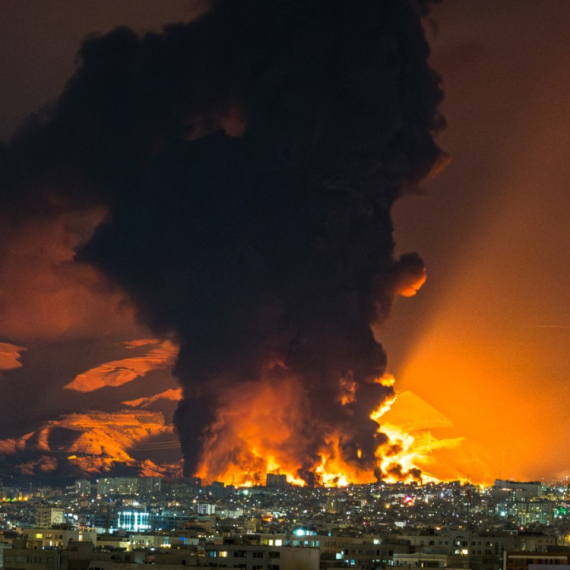
Iranians completely destroy U.S. bases; U.S. waging war from hotels and offices — VIDEO
Iranian attacks have forced U.S. forces to operate from hotels and offices across the Middle East after key military bases were damaged, The New York Times reports, citing U.S. officials and military sources.



Iran has attacked U.S. bases across the region in response to the U.S.-Israeli war, forcing many troops to abandon their positions. According to The New York Times, a large portion of ground forces is now effectively waging the war “remotely,” while pilots and combat aircraft crews continue to carry out strikes.
Iran’s Islamic Revolutionary Guard Corps (IRGC) has called on the public to report new locations of U.S. troops, in an effort to track down dispersed forces. U.S. military officials say the threat has not prevented the Pentagon from continuing operations in a conflict that has now entered its fourth week.
“We have struck more than 7,000 targets across Iran and its military infrastructure so far,” U.S. Defense Secretary Pete Hegseth said last week.
“Today will see the largest package of strikes so far, just like yesterday,” he added.
The relocation of troops to improvised locations—described by one official as “alternative”—raises questions about how prepared the administration of U.S. President Donald Trump was for the war.
War from hotels and improvised centers
At the start of the conflict, there were around 40,000 U.S. troops in the region. U.S. Central Command has since redeployed thousands of them, some even to Europe, while others have remained in the Middle East—but no longer at their original bases, according to The New York Times.
The result, according to current and former military officials, is a war that is significantly harder to conduct.
“Yes, we have the ability to set up temporary operational centers, but you inevitably lose some capacity,” said Wes J. Bryant, a retired U.S. Air Force targeting specialist.
“You can’t just put all that equipment on a hotel roof. Some of it is simply too bulky,” he added. A U.S. official stressed that troops are not operating from the rooftops of civilian hotels.
Heavy strikes on bases and infrastructure
Iran responded forcefully to the joint U.S.-Israeli attacks, targeting not only military bases but also embassies and oil and gas infrastructure across the region.
After the Supreme Leader and dozens of other leaders were killed, the Iranian regime retaliated by launching hundreds of drones and missiles at neighboring countries and largely closing the Strait of Hormuz, a key maritime route, giving the conflict global consequences.
Many of the 13 bases used by U.S. forces have become nearly unusable, with those in neighboring Kuwait among the hardest hit. In an attack on the port of Shuaiba, six U.S. soldiers were killed and a tactical operations center was destroyed.
Iranian strikes also hit Ali Al Salem Air Base and Camp Buehring, damaging facilities and infrastructure. Al Udeid Air Base in Qatar was struck, with its early warning system damaged, while the headquarters of the U.S. Fifth Fleet was attacked in Bahrain. In Saudi Arabia, communications equipment and several fuel tankers were damaged.
Iran targets civilians, risk escalates
A pro-Iranian militia in Iraq carried out a drone attack on a luxury hotel in Erbil at the start of the conflict. Iranian authorities accused the U.S. of using civilians as human shields by housing troops in hotels.
“We are forced to identify and target Americans,” Iran’s Revolutionary Guard intelligence service said, according to the Tasnim news agency.
“It is therefore better not to accommodate them in hotels and to stay away from their locations,” they added, urging citizens to share information via Telegram.
Despite the intense air campaign, Iran still retains some capabilities, admitted U.S. Joint Chiefs Chairman Gen. Dan Caine.
Pentagon under pressure
Caine said layered defenses help protect U.S. forces and interests, but the Pentagon is working to further strengthen defenses in the region. Part of the challenge stems from past wars in Iraq and Afghanistan, where the U.S. quickly established air superiority and built bases close to front lines.
Unlike those adversaries, Iran possesses ballistic missiles, making U.S. bases in Kuwait, Bahrain, Saudi Arabia, and Qatar vulnerable—to the point that troops can no longer remain there long term, officials said.
Some military sources believe the administration misjudged how Iran would respond. Before the war began, non-essential embassy staff were not evacuated, and U.S. citizens were not issued warnings.
Mistakes and risk of escalation
Two former U.S. officials said command centers in Saudi Arabia lacked reinforced roofs, leading to the death of one soldier and injuries to others.
U.S. fuel tankers were deployed without sufficient preparation time, and earlier this month two KC-135 aircraft collided, killing six service members. The incident is under investigation.
Bryant noted that the U.S. military has strong capabilities to operate under decentralized conditions.
“You can cut off the head of the snake, but we will continue to operate until the last soldier,” he said.
However, he warned that such a way of warfare comes at a cost. “You always lose something,” he concluded.
1 Komentari
Možda vas zanima

Džoooons! Zvezda slavila u trileru; "Košarkaški bogovi su nekad pošteni"
Košarkaši Crvene zvezde savladali su večeras Asvel u Vilerbanu rezultatom 84:82 u utakmici petog kola Evrolige.
23:00
13.10.2026.
19 h

Potop Partizana u Areni – Panata se "prošetala"; Penjaroja: "Teško je takmičiti se sa lošim šutem"
Košarkaši Panatinaikosa savladali su Partizan sa 55:72 u okviru petog kola Evrolige.
23:43
13.10.2026.
18 h

Uzbuna u Crnom moru; Bugarska odmah traži pomoć NATO-a
Bugarska je zatražila tehničku pomoć Evropske unije i NATO-a u nastavku istrage o napadima dronovima na dva trgovačka broda u bugarskoj isključivoj ekonomskoj zoni Crnog mora.
22:05
12.10.2026.
1 d

Rat – dan 1.691: Rusija udarila na energetiku Ukrajine; Putin nudi rešenje?; "Evropi preti haos" FOTO/VIDEO
Rat u Ukrajini – 1.691. dan. Kremlj poručio da je ruski predsednik Vladimir Putin spreman na obustavu napada tokom izbora u Ukrajini. Za to vreme, evropske bezbednosne službe upozoravaju na moguće nove ruske operacije protiv članica NATO-a.
23:44
12.10.2026.
1 d

Stariji su ga pili svakog dana, a mi smo ga zaboravili: Napitak koji leči
Sve što je nekada pripremano bilo je isključivo prirodno, iz bašte, a jedan napitak je i te kako uticao na zdravlje naših baka i deka, pa bi trebalo da ga vratimo na sto.
16:39
12.10.2026.
2 d














Komentari 1
Pogledaj komentare Pošalji komentar