






25.02.2026.
8:11
Who can endure longer: Russia and Ukraine after four years on the brink of financial exhaustion
Four years have passed since the beginning of Russia’s invasion of Ukraine. What started as a “regional conflict” has escalated into a global economic shock that has fundamentally changed the way the world trades, spends, and invests.



As Ukraine marks four difficult years since the full-scale Russian invasion on February 24, 2022, the conflict has turned into an exhausting war of financial endurance.
Although human and territorial losses remain at the forefront of global awareness, the key economic indicators of Russia’s invasion reveal immense pressure on the country and its international partners.
Ukraine faces an unprecedented dual challenge: financing a continuous, day-to-day defense against Russian forces while simultaneously preparing the most expensive national reconstruction program in modern European history.
Repelling the Russian military machine has required massive and sustained capital injections over the past four years.
According to recent data confirmed by Andriy Hnatov, Chief of the General Staff of the Armed Forces of Ukraine, a single day of full wartime activity cost the country an astonishing $172 million (€145.7 million) on average in 2025.
As early as 2024, the average daily cost of warfare was around $140 million (€118.5 million), representing an increase of nearly 23%, according to Euronews.
The current operational spending pace of the Ukrainian military suggests that roughly $5 billion (€4.2 billion) per month is required to sustain troops, procure ammunition, and deploy innovative combat technologies, among other needs.
To maintain this level of resistance, Ukraine allocates over 30% of its GDP to the military budget. By comparison, most European countries in peacetime historically struggle to meet the NATO minimum target of 2%.
Such extreme expenditure places the Ukrainian economy under enormous pressure, effectively putting it in a state of full wartime mobilization.
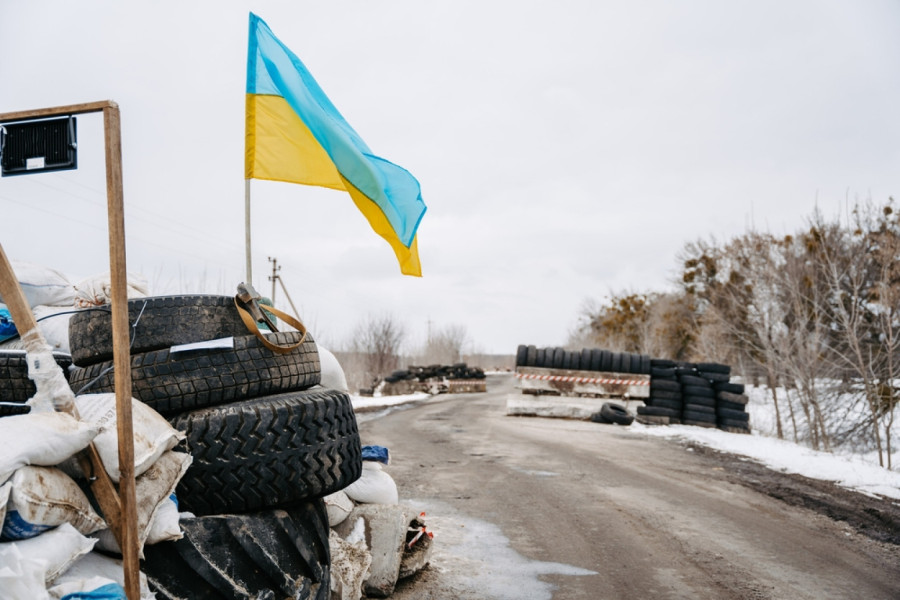
Russian costs
Unlike Ukraine, Russian territory has largely avoided widespread destruction, but cross-border shelling, drone attacks, and incursions have caused measurable damage in regions along the front.
In November 2025, Alexander Bastrykin, head of the Russian Investigative Committee, stated that at least 41 Russian regions had been affected by Ukrainian attacks, causing damage estimated at around ₽600 billion (over $7.8 billion).
However, the main impact on Russia has been on its economy, financial system, and military capability.
Since Moscow does not release comprehensive loss data, economists, international institutions, and independent analysts attempt to quantify the damage through reduced economic output, frozen assets, higher operational costs, and the value of destroyed equipment.
Economic shock and limited growth
The Russian economy suffered an immediate shock following the start of the war in 2022, with the World Bank reporting a 2.1% decline in GDP that year.
Growth returned in 2023 and 2024, supported by fiscal stimulus and increased defense production. However, the recovery masked deeper structural problems. The International Monetary Fund (IMF) estimates cumulative losses in economic potential compared to pre-war projections at around $200–250 billion over four years.
Sanctions have altered Russia’s economic trajectory, restricting technology imports, financial access, and foreign investment. These limitations are expected to affect productivity and long-term growth, although short-term war spending has boosted industrial output.
Frozen reserves and financial pressure
One of the most significant financial blows has been the immobilization of Russian state reserves.
Approximately $300 billion of central bank assets remain frozen in G7 jurisdictions. While not destroyed, these funds are inaccessible, limiting fiscal flexibility and reducing Moscow’s financial buffer against prolonged external pressure.
Loss of access to Western capital markets and borrowing channels has further reduced financial maneuverability.
Energy revenue losses and redirected trade
The energy sector—historically the backbone of Russian federal revenues—has suffered measurable losses.
A 2025 report from the Kyiv School of Economics estimates cumulative losses in Russian oil and gas revenues at around $180 billion since 2022 due to embargoes, redirected trade flows, and price caps.
Russian oil has been sold at discounted prices to buyers, while longer transport routes and limited access to Western services have reduced profitability.
To bypass sanctions and oil price caps, Russia has invested heavily in creating a so-called “shadow fleet” of older tankers. Bloomberg reported at the end of 2025 that over $10 billion was spent on such vessels. Higher insurance premiums and logistical inefficiencies further increased export costs.
Rising costs of war and modernization
Beyond immediate military spending, the conflict has accelerated long-term replacement and modernization costs.
A report by the Royal United Services Institute (RUSI) in early 2026 revealed that Russia increasingly relies on armored reserves from the Soviet era. Replacing these systems with modern equipment like T-90M or T-14 Armata at peacetime production rates could require $150–200 billion over the next decade, according to Anadolu.
Domestic infrastructure needs are also growing. Internal data from the Russian Ministry of Construction indicates that rebuilding municipal heating and water supply systems alone would require at least $50 billion, an investment that could be delayed while defense remains a priority.
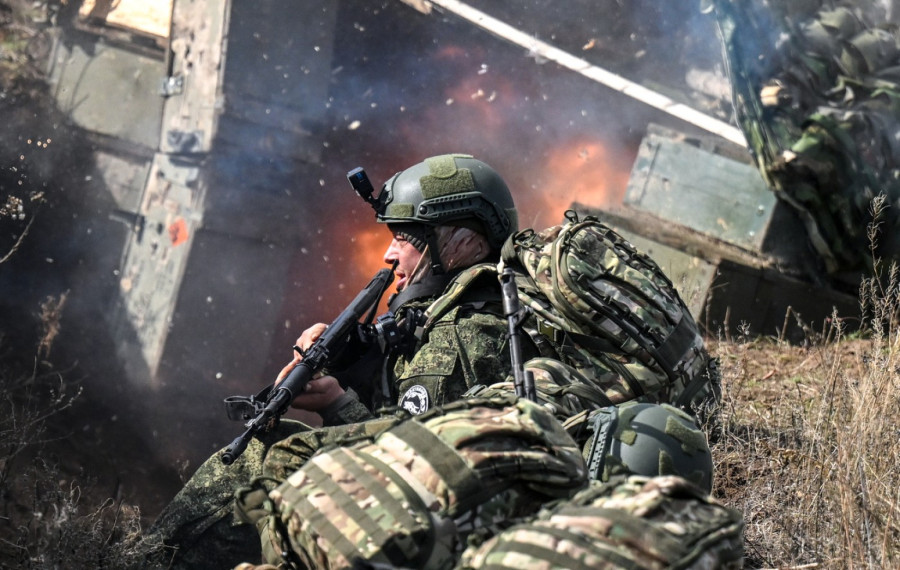
Military equipment losses
Although Russia does not publish official data, Western intelligence and independent assessments provide a picture of the losses. A report by the Center for Strategic and International Studies (CSIS) at the end of 2025 estimates the value of equipment destroyed during the first four years of the war at $80–120 billion.
This includes the loss of more than 3,000 main battle tanks, 6,000 armored combat vehicles, and around 400 aircraft and helicopters.
Some losses carry symbolic weight in addition to their financial cost. The sinking of the warship Moscow in 2022 alone represented a loss of about $750 million. The destruction of multiple Su-34 and Su-35 aircraft—each valued at $40–50 million—further increased the cumulative toll.
Growing burden
Cumulative estimates—including lost GDP, frozen reserves, lost energy revenues, higher operational costs, infrastructure deficits, and military equipment losses—suggest that Russia has suffered financial damage exceeding $1 trillion over four years.
Although the country has avoided widespread physical destruction, the economic and financial consequences of the war are substantial and multi-layered. These include frozen state wealth, reduced export revenues, increased operating costs under sanctions, destroyed military assets, and rising long-term modernization expenses.
Taking all factors into account, while Russia has maintained macroeconomic stability and adapted to sanctions, the cumulative economic burden of the conflict represents one of the costliest strategic undertakings in post-Soviet history.
Recovery is expected to be slow, limited by weak access to foreign capital, reduced borrowing channels, and diminished integration with European markets.
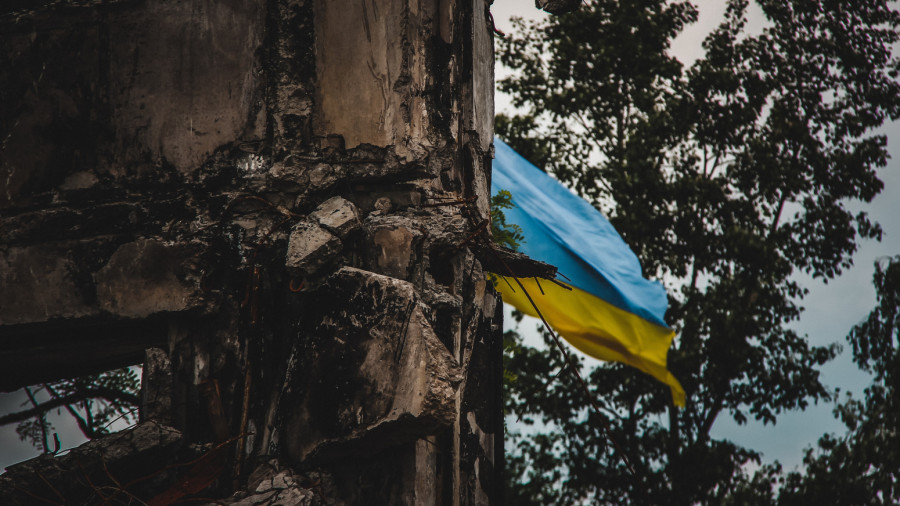
How it has changed Europe
The war in Ukraine has had a profound impact on both European economies and the continent’s security policy. While the United States dominated the early phase of the war as Ukraine’s largest single donor, its new military and financial aid virtually ceased during 2025, as the Washington administration no longer announced significant new support packages. This created a gap that European countries and institutions had to fill.
The European Union also took on a key role through large financial programs and loans, including the European Parliament’s decision to approve a €90 billion loan to Ukraine for 2026–2027. The total mobilized support from the EU and its member states exceeded €193 billion by early 2026, encompassing grants, loans, and military assistance.
Today, European leaders reaffirmed that commitment. European Commission President Ursula von der Leyen stated that “Europe stands unwaveringly with Ukraine, financially, militarily, and through this difficult winter,” emphasizing that support will continue until peace is established on Ukraine’s terms.
European Council and Parliament Presidents Antonio Costa and Roberta Metsola praised the courage of the Ukrainian people and highlighted Europe’s shared determination to secure a just and lasting peace. Leaders from France, Germany, the United Kingdom, Spain, Denmark, and Sweden also pledged continued military, humanitarian, and economic support, underlining that defending Ukraine is simultaneously a defense of European security and the values of freedom, democracy, and human dignity.
3 Komentari
Možda vas zanima

Medvedev diskvalifikovan, Đoković u finalu; Novak: "Šokiran sam, slično mi se desilo" VIDEO
Srpski teniser Novak Đoković pobedio je Danila Medvedeva posle maratonska dva seta u polufinalu Pekinga, ali nakon što je Rus diskvalifikovan.
16:55
5.10.2026.
1 d

Šta ovo bi? De Minor predao Đokoviću za titulu! "Bio sam van domašaja ovakvih rekorda..."
Srpski teniser Novak Đoković osvojio je sedmu titulu u Pekingu, nakon što je Aleks de Minor predao meč na startu drugog seta.
16:28
6.10.2026.
21 h

Rat – dan 1.685: Napadnuta Moskva; Novi udari na Kijev; Rusija: "Pratimo planove NATO-a" FOTO/VIDEO
Rat u Ukrajini – 1.685. dan. Ukrajinske snage izvele udare na Moskvu i oblast oko nje. Moskva je, s druge strane, nastavila da bombarduje Ukrajinu.
23:55
6.10.2026.
14 h

Hrvatska u neverici – Merino utišao "Poljud" sa dva gola! VIDEO
Hrvatska je imala veliki "skalp" u rukama i, da je iskoristila sve prilike, mogla da pobedi svetskog i evropskog šampiona, a na kraju je ostala potpuno praznih šaka
22:36
6.10.2026.
15 h

Beogradske ulice menjaju imena: Među njima i najprometniji gradski bulevar, evo koje će ime od sada nositi
Na dnevnom redu su i predlozi da ulice dobiju imena Bratislava Brace Petkovića, Milovana Vitezovića i naziv Taškentska.
17:39
5.10.2026.
1 d












Komentari 3
Pogledaj komentare Pošalji komentar