




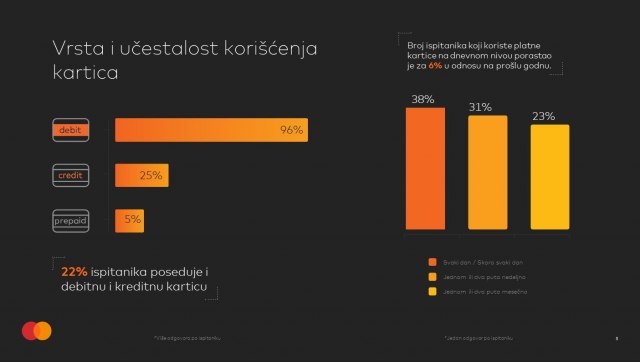
38 percent of all daily transactions are paid with cards
The frequency of card payments is a good indicator of the extent to which plastic money has taken root in the market.
Friday, 30.06.2023.
10:51
38 percent of all daily transactions are paid with cards
When looking at the type of payment product found in respondents' wallets, the majority are debit cards, owned by as many as 96 percent of respondents, while every fourth respondent owns a credit card.Payment cards are most often used for purchases in supermarkets (69%), clothing and footwear stores (55%), local grocery stores (49%), and gas stations (43%). On the other hand, all markets and newsstands are the most frequently mentioned locations where 27 percent of respondents would like to pay with cards, which is another indicator of the habit payment card users in Serbia are acquiring.
The reason for the frequent use of payment cards lies primarily in the simplicity and practicality of this payment method, which was highlighted by 27 percent of the respondents, while another 24 percent value constant access to funds in the account. What would further encourage the use of payment cards are discounts at certain shops, as stated by 58 percent of respondents, it is also interesting that 44 percent of respondents claim that a wider acceptance network could be of use too.
"The survey conducted by MasterIndex Serbia showed that we all see cashless payments, primarily cards, as an integral part of our everyday life. With the fact that payments with cards and mobile wallets are the first choice even for payments of smaller amounts up to 4,000 dinars, with 59 percent of respondents who said that versus 37 percent who opt for cash, the digital commitment of citizens is also confirmed by information that for the first time, mobile wallets are the reason why citizens choose to use card payments. Citizens already recognize that the future is digital, and we will continue with the implementation of modern payment and security technologies on the Serbian market to enable individuals, businesses, and the public sector to use these digital potentials," said Jelena Ristić, director of the Mastercard company for the Serbian, Bosnian and Montenegrin market.
Users in Serbia most often choose domestic web shops
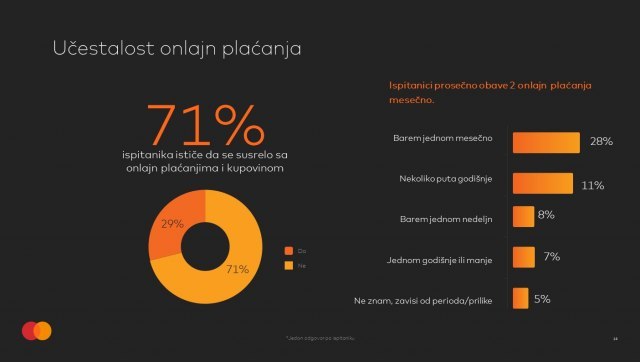
Monthly bills continue to top the list of things paid online (56%, up 9 percent from last year). In addition to paying bills, users shop online for clothes (54%, 10% more than last year) and food (33%). In addition to cash on delivery, an option used by two-thirds of respondents, 39% of respondents said they pay by card online, while another 15% say they pay by card on delivery, an option that Mastercard introduced to the market in 2022.
Domestic web stores are still a more frequent shopping address than foreign online shops (55% vs. 6% of respondents), with one-fifth of respondents without a preference. Ten percent of respondents pointed out that they also buy via social networks, Instagram, and Facebook.
About MasterIndex study
The MasterIndex Serbia survey is a traditional annual survey examining the habits and needs of active payment card users in Serbia. The survey has been conducted every year since 2009 and was conducted on a representative sample of citizens from all over Serbia over the age of 18.0 Komentari
Možda vas zanima

Sve je palo u vodu: Neće biti dogovora
Belgija se usprotivila predlogu Evropske komisije za deblokiranje kredita Ukrajini od 210 milijardi evra finansiranog zamrznutom ruskom imovinom i uništila nade EU za dogovor do samita lidera.
16:40
16.12.2025.
2 d

Mađarska potpisala: "Isporučujemo gas"
Mađarska je danas potpisala ugovor sa Sjedinjenim Američkim Državama o isporuci 400 miliona kubnih metara tečnog prirodnog gasa (TPG) godišnje, izjavio je mađarski ministar spoljnih poslova i trgovine Peter Sijarto.
17:38
16.12.2025.
2 d

Zagrmeo je: Mrtva je
Ideja da EU koristi zamrznutu rusku imovinu, koja se uglavnom nalazi u Briselu, kako bi finansirala Ukrajinu mrtva je jer postoji manjina koja je protiv toga, izjavio je danas madjarski premijer Viktor Orban.
10:16
18.12.2025.
11 h

Debakl Partizana – Ocokoljić se izvinio i saopštio loše vesti; Oglasio se i Parker VIDEO
Košarkaši Partizana poraženi su od Virtusa sa 86:68 u "Beogradskoj areni", u okviru 16. kola Evrolige.
23:50
17.12.2025.
21 h

Oglasio se PIO Fond: Važno upozorenje svim penzionerima
Republički fond za penziјsko i invalidsko osiguranje obaveštava korisnike penziјa da su aktuelni novi pokušaјi prevare penzionera.
11:22
17.12.2025.
1 d





Komentari 0