






27.01.2026.
15:11
And the nightmare has come true: Europe left in the lurch
The new U.S. National Defense Strategy for 2026, recently published, will implement a profound shift introduced by the Trump administration, whose essence is that Europe is largely left without American defense support.



According to the latest strategy, U.S. defense will prioritize its own country, the Western Hemisphere, and the Indo-Pacific region, while Europe is increasingly treated as a secondary area due to the weakening of its relative economic power, writes Defence24.
They say they will “remain engaged in Europe,” but…
As reported by the Croatian portal Index, the U.S. strategy assures that America will remain “engaged” in Europe, but will “adjust the deployment of its forces and activities on the continent.”
The focus is shifting from quantity to quality, giving priority to “limited but critical” support.
Europe is therefore expected to take “primary responsibility” for its conventional defense, while the U.S. will concentrate on providing strategic support such as intelligence sharing, operational planning, and advanced military capabilities.
America insists on spending 5% of GDP on defense
A central part of this approach is meeting NATO allies’ commitment to allocate 5 percent of GDP to defense, which the U.S. Department of Defense aims to “encourage and enable.”
To this end, Washington plans to leverage NATO processes, expand transatlantic defense-industrial cooperation, and reduce barriers to trade in defense equipment to accelerate European rearmament.
U.S.: Russia is a lasting but manageable threat
The strategy describes Russia as a “lasting but manageable threat to NATO’s eastern members in the foreseeable future.” This assessment is based on the Kremlin’s “large military and industrial reserves” as well as the “national resolve” demonstrated in the prolonged war against Ukraine.
Despite this, the document claims that “Moscow is not in a position to pursue European hegemony” because, as it states, the “European NATO” far surpasses Russia in population and economic strength, and thus in potential military power.
The U.S. expects Europe to take the lead in supporting Kyiv
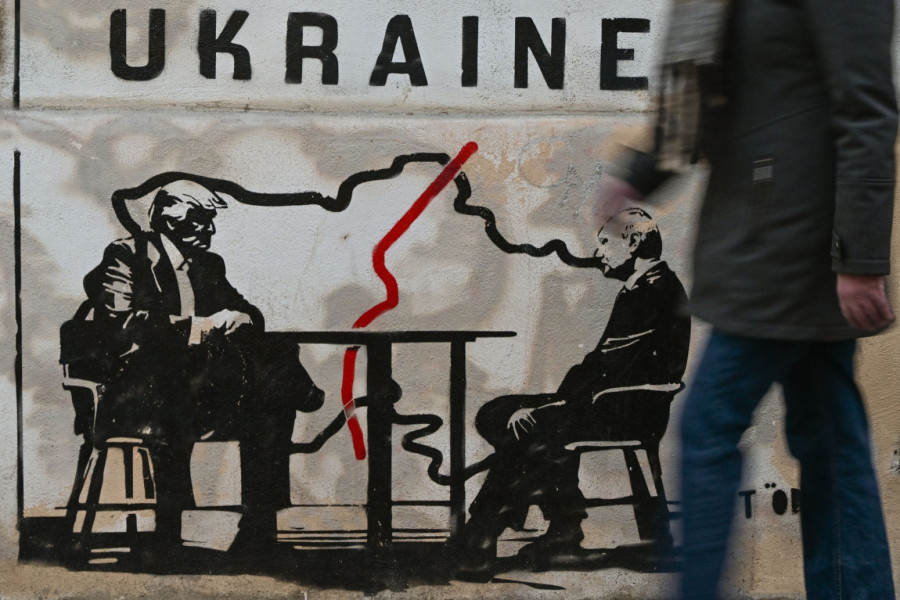
Based on this reasoning, it is concluded that Europe is ready to take “primary responsibility” for its conventional defense. The same logic applies to Ukraine: Europeans are expected to take the lead in sustaining support for Kyiv and bear primary responsibility for ending the war.
The strategy also aims to maintain a “favorable balance of power” against all major competitors, including China, Russia, Iran, and North Korea.
Achieving this goal requires a greater burden-sharing with allies, with Europe expected to take care of Europe.
In this sense, the strategy follows the logic of threat perception, according to which each ally is expected to focus on its most immediate challenge. This principle is formulated as follows: “In Europe and other areas, allies will take the lead against threats that are less serious for us but more serious for them.”
More broadly, Europe is viewed as part of the “defensive perimeter around Eurasia”, which includes U.S. allies and partners such as Japan, South Korea, and Australia.
Some allies become more assured of U.S. support than others
The strategy makes it crystal clear that the U.S. is willing to play only a limited, supporting, and conditional role in Europe’s defense. This implies that “model allies” will have priority access to American cooperation, effectively creating a hierarchy within NATO in which some allies are more secure in Washington’s support than others.
At the same time, Europe is essentially told to mind its own business and not interfere with U.S. priorities, stating: “Finally, we will be clear with our European allies that their efforts and resources are best directed toward Europe.”
America wants a strong Europe, but not too strong
In the logic of spheres of influence of the current administration, this may mean that Washington wants a Europe strong enough to secure its own region, but not so strong—or globally influential—that it begins to compete with U.S. interests.
Moreover, terms like “European NATO” and “NATO without the U.S.” are mentioned repeatedly, reinforcing fears of a U.S. distancing from European allies and the Alliance itself.
This is happening amid the deepest transatlantic crisis since NATO’s founding, triggered by American threats regarding Greenland, which the text mentions five times as a key area for U.S. security.

Interestingly, the document explicitly calls on Europe to take care of its conventional defense, with the word “conventional” implicitly excluding the nuclear deterrence provided by the United States.
At least rhetorically, this suggests that Washington intends to retain its nuclear umbrella for the Alliance, rather than encouraging Europe to independently assume responsibility for that component as well.
0 Komentari
Možda vas zanima

Dvostruka državna pomoć za penzionere: Evo šta ih očekuje pored novog povećanja penzija
PIO fond je obezbedio sredstva za jednokratnu pomoć, čiji će iznos zavisiti od visine penzije, dok penzionere očekuje i novo povećanje primanja.
9:01
20.9.2026.
13 h

Evo kada počinje zimsko računanje vremena: Tokom ove noći očekuje nas pomeranje sata
Prelazak na zimsko računanje vremena u 2026. godini očekuje nas u noći između 24. i 25. oktobra, kada se kazaljke vraćaju sa tri na dva sata ujutru. Saznajte zašto je uvedeno pomeranje sata, kao i kako utiče na zdravlje.
18:28
19.9.2026.
1 d

Najluđi meč sezone! Partizan išao ka debaklu, pa se dva puta vratio iz mrtvih VIDEO
Nešto u Humskoj, definitivno je, mora da se menja. Ali šta?
20:52
19.9.2026.
1 d

Rat – dan 1.667: Pogođena nuklearna elektrana u Rusiji; Eksplozije u Kijevu; Rusi napali Sumi FOTO/VIDEO
Rat u Ukrajini – 1.667. dan. Bespilotna letelica pala je na rashladni toranj prvog energobloka Kurske nuklearne elektrane 2 i eksplodirala, saopštio je "Rosatom". Rusi su napali grad Sumi – oštećene su stambene zgrade, a dve osobe su poginule.
23:52
18.9.2026.
1 d

uživo Osveta je stigla – gori u prestonici; Ispaljeno preko 1.000 dronova; Razgovarali Tramp i Zelenski FOTO/VIDEO
Rat u Ukrajini – 1.669. dan. Dve osobe su poginule, a šest je povređeno u masovnom napadu ukrajinskih dronova na Moskovsku oblast, gde je, prema navodima ruskih vlasti, oboreno i potisnuto 249 letelica.
21:42
20.9.2026.
31 min












Komentari 0
Pogledaj komentare Pošalji komentar