






30.07.2026.
11:10
Extreme heat warning: Melting asphalt and tire blowouts pose a risk to everyone PHOTO
The State Hydrometeorological Institute of Serbia (RHMZ) issued an orange weather alert for the entire territory of Serbia this morning.



“Dangerous weather phenomena are forecast, with an intensity that may cause material damage and pose a risk to people and animals. It is necessary to be extremely cautious, aware of the risks, and regularly informed about the details of the expected weather conditions. Follow the advice issued by the competent state authorities,” the RHMZ website states.
The beginning of a prolonged heatwave in the territory of the Republic of Serbia will be marked by maximum temperatures of 33 to 37°C today (July 30), while from Friday (July 31) temperatures will range from 35 to 38°C, locally reaching up to 40°C.
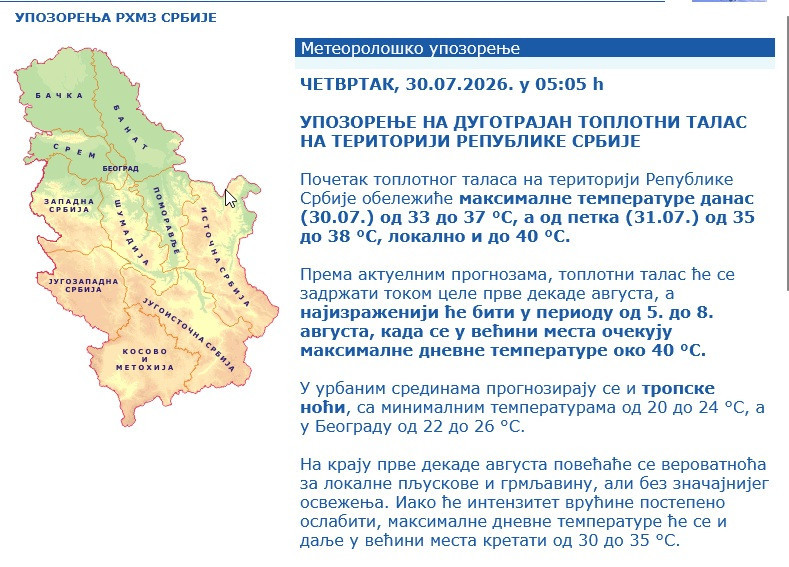
According to the latest forecasts, the heatwave will persist throughout the entire first ten days of August, with the most intense period expected from August 5 to August 8, when maximum daytime temperatures of around 40°C are forecast in most areas.
Tropical nights are also expected in urban areas, with minimum temperatures ranging from 20°C to 24°C, while in Belgrade they are expected to be between 22°C and 26°C.
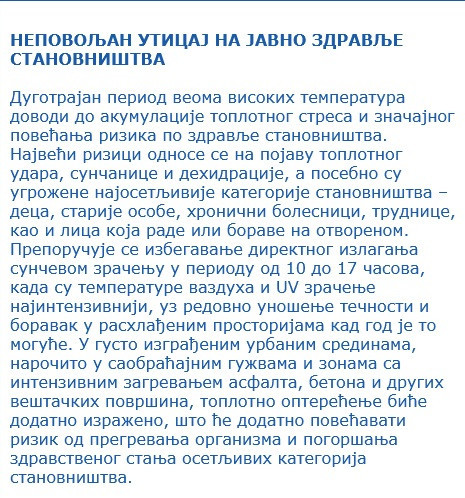
A prolonged period of high temperatures, combined with the drying out of vegetation and soil, significantly increases the risk of wildfires breaking out and spreading rapidly in open areas. Forest areas, agricultural land, low vegetation, and neglected land are particularly vulnerable.
Under such conditions, fires can spread quickly even with light winds, further complicating efforts to contain and extinguish them.
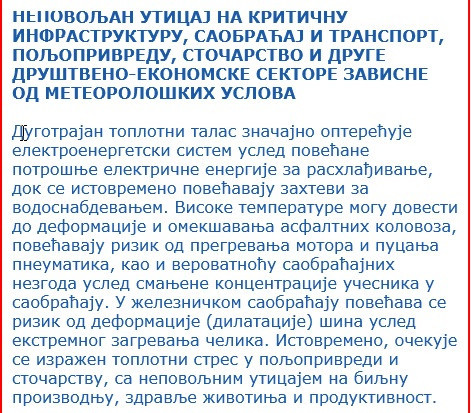
A prolonged heatwave places significant strain on the power grid due to increased electricity consumption for cooling, while demand for water supplies is also rising at the same time.
High temperatures can cause road asphalt to soften and deform, increase the risk of engine overheating and tire blowouts, and raise the likelihood of traffic accidents due to reduced concentration among road users.
In railway transport, the risk of rail deformation (thermal expansion) increases due to the extreme heating of steel tracks. At the same time, significant heat stress is expected in agriculture and livestock farming, with adverse effects on crop production, animal health, and productivity.
Beograd

8°C
Vedro nebo
Max temp: 16°C
Min temp: 7°C
Vlažnost: 71%
Vetar: 2 m/s
Pritisak: 1018 mb
Niš
4°C
Vedro nebo
Max temp: 19°C
Min temp: 7°C
Vlažnost: 100%
Vetar: 1 m/s
Pritisak: 1020 mb
Novi Sad

9°C
Mestimično oblačno
Max temp: 18°C
Min temp: 8°C
Vlažnost: 75%
Vetar: 3 m/s
Pritisak: 1018 mb
Kragujevac

7°C
Mestimično oblačno
Max temp: 20°C
Min temp: 7°C
Vlažnost: 85%
Vetar: 1 m/s
Pritisak: 1019 mb
Užice
5°C
Mestimično oblačno
Max temp: 19°C
Min temp: 5°C
Vlažnost: 88%
Vetar: 2 m/s
Pritisak: 1018 mb
Subotica
7°C
Mestimično oblačno
Max temp: 15°C
Min temp: 5°C
Vlažnost: 83%
Vetar: 2 m/s
Pritisak: 1019 mb
0 Komentari
Možda vas zanima

Partizan srušio Zvezdu; Pajola heroj! Karlik: "Nemam reči"; Italijan objasnio pobedu crno-belih
Košarkaši Partizana pobedili su Crvenu zvezdu rezultatom 85:82 u 7. kolu Evrolige.
23:57
22.10.2026.
1 d

Neverovatni prizori u 150 mesta u Srbiji: Okupljanja i podrška listi "Ujedinjena Srbija"; Orio se "Ruzmarin"
Građani Srbije u 150 gradova i sela organizovali su skupove poslednjeg dana izborne kampanje kako bi iskazali podršku listi "Aleksandar Vučić – Ujedinjena Srbija".
22:19
22.10.2026.
1 d

Cure šokantni detalji hapšenja; SAJ objavio snimke; Planiran haos na dan izbora VIDEO
U Novom Sadu i Vrnjačkoj Banji uhapšene vođe kriminalnih grupa zbog sumnje da su organizovali i planirali nerede na dan izbora 25. oktobra. Prema najnovijim informacijama, obojica imaju pasoše Hrvatske. Uhapšen i ultradesničar iz Zemuna, navode mediji.
12:42
21.10.2026.
2 d

Zvezda umalo opet sve prosula; Rijera nije zabrinut; Elšnik neće da "baca saigrače pod autobus"
Fudbaleri Crvene zvezde remizirali su sa Kopenhagenom 2:2 na stadionu "Rajko Mitić" u drugom kolu Lige konferencije.
22:14
22.10.2026.
1 d

Rat – dan 1.671: Rusi ponovo napali Kijev; Putin: "Možemo da postignemo dogovor" FOTO/VIDEO
Rat u Ukrajini – 1.671. dan. Rusi su u toku noći pokrenuli novi udar na Kijev. Ruski predsednik Vladimir Putin izrazio je danas uverenje da Rusija i Ukrajina mogu da postignu dogovor.
23:58
22.10.2026.
1 d












Komentari 0
Pogledaj komentare Pošalji komentar