






22.09.2026.
9:43
It's over: Everything "fell" in just 18 hours PHOTO/VIDEO
The Houthis have seized control of Yemen’s entire Red Sea coastline, giving them access to the key maritime chokepoint of Bab el-Mandeb and taking their conflict with Saudi Arabia, Israel and the rest of the world to a new level.



The Yemeni rebels have dealt a major blow to the Saudi-backed Yemeni government, with analysts describing the development as the most significant regional shift since the United States and Israel declared war on Iran.
The roots of the conflict with Riyadh date back to 2004, when the Shiite movement Ansar Allah, better known as the Yemeni Houthis, first took up arms against then-Yemeni President Ali Abdullah Saleh and accused Saudi Arabia of funding and directing his campaign against their community in the northern province of Saada.
After the Houthis capitalized on widespread anger over corruption in 2014 and seized the capital, Sanaa, forcing the president to flee to Aden, Saudi Arabia entered the war at the head of a coalition of Arab states, officially with the aim of restoring the internationally recognized government to power, but also driven by fears of an Iranian foothold on its southern border and a desire to secure control over Bab el-Mandeb, a key export route for Saudi oil.
Houthis Seized the Coast in 18 Hours
The Houthis’ second conflict, with Israel, has a different background. Index notes that the Yemeni rebels have used a slogan known as “al-Sarkha” (“The Scream”) since almost the movement’s founding in the 1990s: “God is the greatest, death to America, death to Israel, a curse upon the Jews, victory to Islam.” The slogan is part of a broader anti-imperialist and anti-Zionist ideology influenced by Iranian revolutionary rhetoric.
However, until 2023, the slogan remained largely symbolic. That changed after Hamas’s attack on Israel on October 7, 2023, when the Houthis began launching missiles and drones toward the Israeli port city of Eilat and attacking ships in the Red Sea, saying they were acting in solidarity with Gaza.
In the following months, they struck Tel Aviv with one missile that killed one person, while other missiles were intercepted by Israeli, American and French air defenses.
That pattern continued in waves, with the ceasefire in Gaza in October 2025 temporarily reducing the attacks. However, renewed fighting between Israel and Iran this year prompted the Houthis in June to reinstate their blockade of ships linked to Israel, drawing the Yemeni conflict deeper into the wider regional war.
The two fronts are now intertwined: the experience and weapons acquired through the war with Israel and attacks on ships in the Red Sea, including ballistic missiles and drones obtained with Iranian assistance, have enabled the Houthis to outmatch the fragmented forces of the Yemeni government and seize the entire coastline in a lightning offensive that lasted just 18 hours.
Analyst Mohamad Elmasri of Qatar’s Doha Institute said this is a “more advanced fighting force than the one the Saudis faced a decade ago,” adding that access to Iranian weapons has enabled the Houthis to build an impressive arsenal.
Bab el-Mandeb
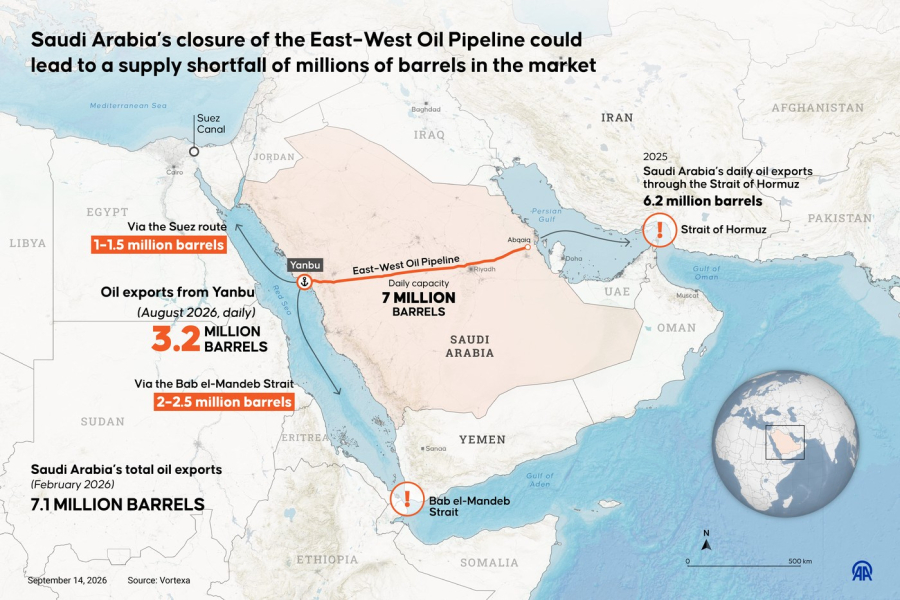
The waterway, through which around 12% of global trade passes each day, has become even more important since Iran closed the Strait of Hormuz, which before the war handled around one-fifth of the world’s energy supplies annually.
Saudi Arabia subsequently increased the capacity of its oil pipeline carrying crude across the Red Sea to its maximum, from five million to seven million barrels per day. As a result, 21% more Saudi oil is now being transported toward Bab el-Mandeb than before the war.
That is precisely what made the strait the Houthis’ number-one target. As a result of the Houthi attacks, the flow of Saudi oil through the strait has fallen by nearly 50%, while global markets have responded with a further rise in oil prices.
The International Energy Agency said that global oil supply is expected to decline more than previously forecast this year, while OPEC has cut its forecast for global oil demand growth in 2026 for the fifth consecutive time.

0 Komentari
Možda vas zanima

Poznati lanac zatvara 150 prodavnica: U toku su rasprodaje na više lokacija
Diskontni lanac KiK nastavlja da smanjuje broj svojih prodavnica u Nemačkoj. Tokom 2026. godine planirano je zatvaranje oko 150 objekata, dok bi istovremeno trebalo da bude otvoreno svega petnaestak novih.
16:19
11.10.2026.
23 h

Rat – dan 1.688: Kijev u mraku; Ukrajinski dronovi pogodili Omsk i Uhtu FOTO/VIDEO
Rat u Ukrajini – 1.688. dan. Ruski napadi teško su oštetili energetsku infrastrukturu Ukrajine, dok je gradonačelnik Kijeva Vitalij Kličko pozvao građane da privremeno napuste prestonicu. Ukrajinske snage su potvrdile napade na ruske rafinerije.
23:54
9.10.2026.
2 d

Na granicama više ništa nije isto: Svi su strahovali od EES-a, a čeka nas novi sistem
Prošlo je godinu dana od početka uvođenja sistema ulaska i izlaska (EES) na spoljnim granicama Evropske unije, koji je doneo velike promene u načinu kontrole putnika iz zemalja koje nisu članice EU.
17:13
10.10.2026.
1 d

Rat – dan 1.690: Primirje prekršeno; Rusija udarila na Harkov; Evropi stiglo mračno upozorenje FOTO/VIDEO
Rat u Ukrajini – 1.690. dan. Američki predsednik Donald Tramp objavio energetsko primirje između Rusije i Ukrajine, za koje ukrajinski predsednik kaže da je prekršeno. Na frontu se nastavljaju napadi, a Kijev i Moskva razmenjuju optužbe i upozorenja.
23:50
11.10.2026.
16 h

"Pukla stotka" u Pioniru za prvu pobedu Zvezde u ABA ligi, ali brine nova povreda
Košarkaši Crvene zvezde su savladali ekipu Budućnosti u trećem kolu ABA lige rezultatom 101:91 i time upisali porvi trijumf u regionalnom takmičenju u novoj sezoni.
23:25
10.10.2026.
1 d












Komentari 0
Pogledaj komentare Pošalji komentar