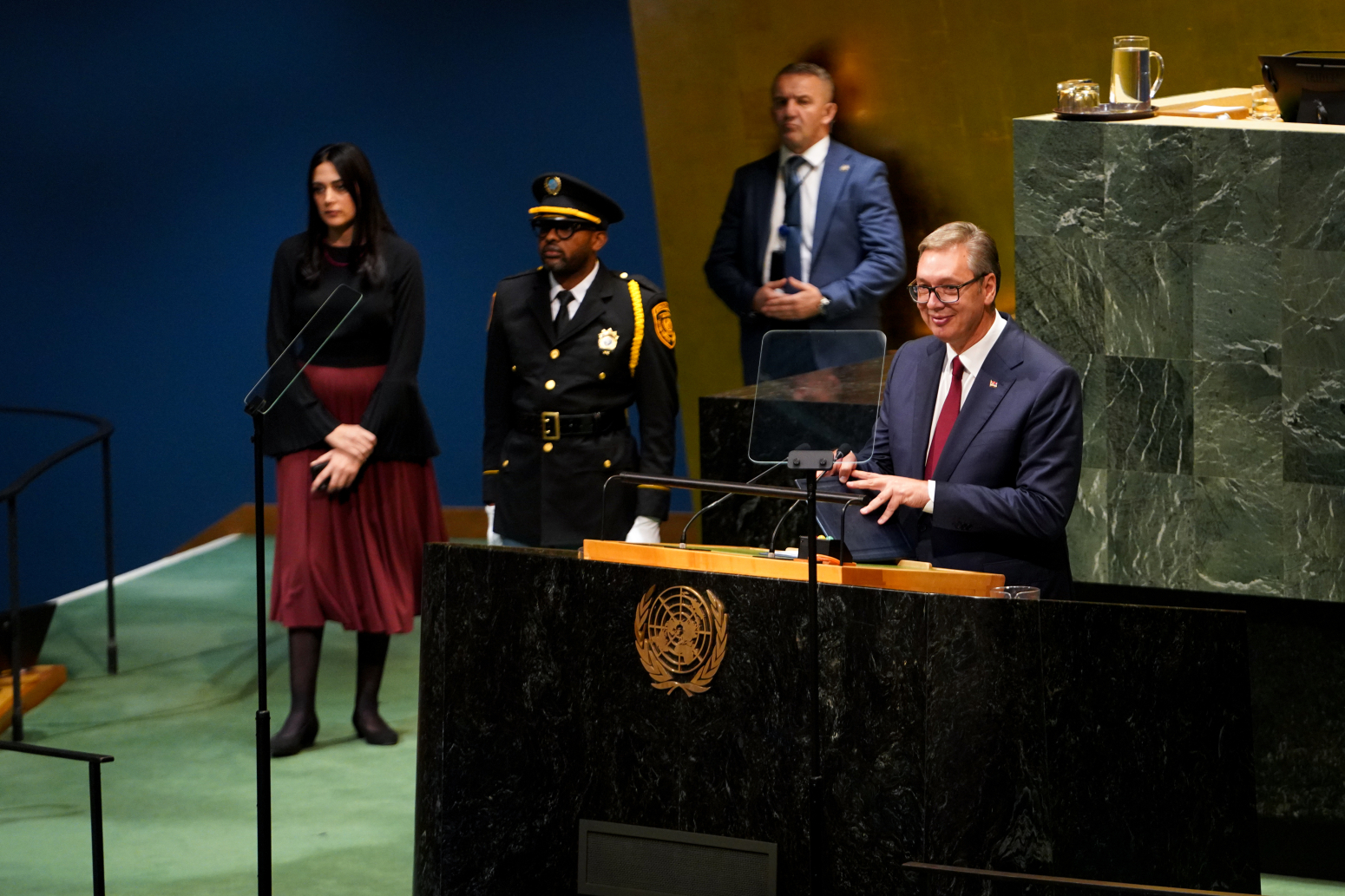
“Mr. President of the General Assembly, Excellencies, Ladies and gentlemen,
The theme of this year’s session — rebuilding trust, managing transformation, delivering results for all — partially describes the moment we find ourselves in. I agree that we need to restore trust in the United Nations, but I am not sure to what extent we can manage transformation in many areas.
Today, we are witnessing the emergence of new orders, alongside strong regional actors seeking to independently influence broader global processes. This is not just about conventional armed conflicts between states. The line between peace and conflict is becoming increasingly blurred, and the consequences are rapidly affecting even those states that are not directly involved.
Such an environment represents an enormous challenge. Pressure on states to choose one side or the other is becoming increasingly intense,” Vučić said.
He added that the traditional system of international justice is seriously under threat and that the same rights do not apply to everyone.
“The problem is not the existence of the law, but compliance with it. Everyone talks about and invokes the UN Charter, the spirit of the Charter, and the principles on which the world order that was in force until recently was based. It is as if they want to tell us that these principles no longer apply.
We have opened Pandora’s box, and it is impossible to close it. How many times over the past two days have you heard calls from this podium for respect for international law? The majority of countries remain shamelessly silent, while some have participated in undermining the Charter,” he said.
Vučić noted that he was referring to all countries that have recognized the independence of the so-called independent Kosovo.
“Many of you may see this as a distant past, but the wounds inflicted on international law are becoming deeper and more serious. The order established by the Charter and international law no longer exists. It was dismantled for political interests. They did so without scruples.
The only official reason given for the attack on Serbia carried out by 19 NATO countries was that they were attacking the country in order to prevent a humanitarian catastrophe. It did not happen, and I have yet to hear where it happened. The attack on that small, freedom-loving country was carried out with the desire to finally establish an order following the Second World War,” he said.
According to him, they trampled on Serbia, but they did not defeat it.
“Serbia rose like a phoenix. The consequences of that brutal attack on Serbia are significant and particularly visible here in this Assembly. There are no principles anymore. Those who trampled on them have no moral right to speak about them. To make the hypocrisy even greater, those very countries have assumed the role of supreme teachers of morality.
How did you treat Kosovo and Metohija and Serbia’s territorial integrity?
For us in Serbia, the most difficult thing is to see the renewed rise of Nazism as a pillar of social values in our neighborhood, particularly in the Republic of Croatia, which takes pride in its Nazi past and in the use of Nazi slogans and symbols today. The Serbian people, as the nation that suffered the most at the hands of the Nazis, cannot accept the revival of the most terrible ghosts of the past, responsible for the deaths of hundreds of thousands of Serbs, Jews and Roma in monstrous concentration camps such as Jasenovac. That is precisely why the moral lectures we hear from such countries are completely unacceptable to the Serbian people and Serbia,” he said.
Tanjug/JADRANKA ILIĆ (STF)
When he raises these questions, he added, there is either no answer, or he is told not to look to the past but to the future.
“When I ask about Ukraine, we end the pointless conversation and move on to another topic. All of you here who belong to the Global South, pay attention when signing agreements with major powers.
We signed the Brussels Agreement in order to resolve conflicts, and we fulfilled all the obligations we were required to fulfill. Their obligation has still not been fulfilled to this day. It was confirmed by the EU’s signature, but that meant nothing. We are facing all kinds of pressure to abandon the implementation of what was signed.
Despite everything, Serbia will defend its integrity.
As President of Serbia, for 10 years I have faced all kinds of tricks and pressure aimed at making us abandon the full implementation of what was signed. This is a lesson for us Serbs, but also for everyone else in the world who wants to protect and preserve their country.
Despite everything, Serbia will defend its country, its territorial integrity, the UN Charter, and UN Security Council Resolution 1244,” Vučić said.
He also thanked each of the 107 countries individually that have not recognized the unilaterally declared independence of the so-called Kosovo.
“We know that many of these countries have been subjected to pressure, and we know that maintaining a principled position is sometimes much more difficult than it may appear from the outside. Thank you for your consistency in refusing to recognize the independence of a part of Serbia’s territory.
Serbia is on the European path and will still have to do a great deal in order to become a full member of the EU. We are grateful to the European Union, particularly European Commission President Ursula von der Leyen and European Council President António Costa, for every kind of assistance they have provided and continue to provide to our country.
Although full EU membership remains a strategic priority, we cannot fail to notice the long-standing fatigue with the enlargement process, both among some EU member states and among candidate countries,” he noted.
He stressed that Serbia’s European path is a good example of the length and complexity of this process.
“We obtained candidate status in 2012 and began accession negotiations as early as 2014, more than 12 years ago. Serbian citizens therefore have every right to expect a clearer perspective and more concrete results from a process in which our country has been participating for more than a decade.
Given that it is uncertain whether the next enlargement of the European Union will take place in the near future, we have sought to be constructive and offer practical ways to overcome the existing deadlock.
That is why we proposed that the Western Balkans be gradually integrated into the European single market and granted access to the Schengen Area even before full EU membership. This would not represent a substitute for membership, nor a lowering of our ambitions, but rather a concrete and pragmatic way forward that would allow the citizens and economies of the region to experience tangible benefits from European integration and help overcome the deadlock in which the enlargement process has remained for too long,” he said.
However, Vučić added, a stable and integrated Europe, of which Serbia is a part, and our European path do not mean abandoning the traditional friendships that have helped make Belgrade one of the few European capitals from which it is possible to fly directly to the United States, the People’s Republic of China, and the Russian Federation.
“I would like to express my special gratitude to President Xi Jinping of the People’s Republic of China for his support during the COVID-19 pandemic, as well as for the enormous investments and capital placed in Serbia, with the hope that his talks with President Trump will be productive and contribute to stabilizing the situation in the world.
At the same time, we maintain ties with our traditional friends and partners in Africa, Asia and Latin America, with whom we recently marked in Belgrade the 65th anniversary of the First Conference of Non-Aligned Countries, held in our capital in 1961.
Our openness is an expression of our development strategy, our history and our understanding of the world. Serbia believes that countries can have a clear course and pursue their own interests without closing the door to those with whom they do not agree on everything. After all, a world in which we speak only to those who think like us would have little need for diplomacy. Freedom and independence in decision-making are Serbia’s highest values,” he said.
He also said that we must anticipate the consequences of a world in which force is once again being presented more openly as the most reliable instrument of politics, military budgets are growing, conflicts are multiplying, arms-control mechanisms are weakening, and channels of communication are disappearing precisely when they are most needed.
“That is why we must ask an essential question: Where are the United Nations in such a world? The Security Council is often blocked precisely in crises in which it should be most active. Other parts of the UN system are facing financial pressures, overlapping responsibilities, bureaucratization and legitimate demands from member states to see more concrete results.
These are real problems, and there is no benefit in glossing over them. But that certainly does not mean that we need the United Nations any less. We may need them more than ever; they simply need to be more effective, more focused and more prepared to address the issues for which they were created.
Over the past eight decades, states did not come to this building because they had the same interests, but because they understood that the price of resolving disagreements through armed force was too high. That is why multilateralism emerged, and that is why we are here today,” he added.
Vučić stressed that Serbia supports the United Nations and reform of the UN system so that the Organization can become more effective and better adapted to today’s reality.
“We advocate for a more representative UN Security Council, through greater representation of developing countries, particularly from the African continent, as well as through more inclusive regional representation and the addition of another seat for the Eastern European Group of countries.
However, without a genuine return to the principles on which we have already agreed, I do not expect there to be progress in terms of the Organization’s concrete results. Peace is not the only test of our ability to manage change,” he said.
He added that we are in the midst of a technological transformation whose full scope we are only beginning to understand.
“Artificial intelligence is already changing the economy, education, medicine, security, the labor market and the way states function. It can bring enormous benefits to humanity. It can also deepen existing inequalities, enable new forms of manipulation and create security risks that, just a few years ago, we could not even have imagined.
During our leadership term in the Global Partnership on Artificial Intelligence — GPAI, which Serbia chaired in 2025, one of our priorities was to ensure that technological progress remains connected to security, human rights, the rule of law, accountability and reducing the digital divide.
The Belgrade Ministerial Declaration received the support of 44 member states and the European Union and confirmed the need for safe, sustainable and human-centered artificial intelligence,” Vučić said.
According to him, the more powerful technology becomes, the more responsible the people who control it must be.
“We can have the most advanced algorithms, quantum computers, unmanned systems and artificial intelligence capable of processing in a few seconds what once took us years, but if at the same time we allow the basic rules of the international order to be applied selectively, technological progress will not make the world safer. It will only make us technologically more advanced in a world that is becoming politically less predictable.
If we want to responsibly manage the transformation that lies ahead, we must first strengthen the foundations on which the international order rests. These foundations are simple: the sovereign equality of states, respect for territorial integrity, the prohibition of the use of force except in cases clearly provided for by the UN Charter, and the obligation not to change the rules from one case to another,” he explained.
“To those of you who know Serbia and our region, as well as those who are less familiar with this part of the world, I would like to express my gratitude to everyone who honored Serbia by confirming their participation in EXPO 2027, which will be held in Belgrade next year under the theme ‘Play for Humanity: Sport and Music for All.’
In Belgrade, cultures, science, sports, technology, business and young people from all parts of the world will come together, and I look forward to welcoming many of the countries that are represented in this hall today.
At the beginning, I spoke about trust and responsibility, and I would like to end there as well. We will not restore trust through grand declarations if we continue to act as we did before. Each of us must begin with our own decisions.
Serbia is trying to do this by preserving peace in its neighborhood, participating in peacekeeping missions far from its borders, helping others when they are in danger, engaging in dialogue even with those with whom it disagrees, and fulfilling the obligations it undertakes.
What will restore trust in international law and in the United Nations is more action of this kind. Thank you,” Aleksandar Vučić concluded.
Odluka je doneta glasanjem na 28. Generalnoj konferenciji za tegove i mere, a do stupanja na snagu novih pravila neće biti dodavanja novih prestupnih sekundi, što u praksi znači da se njihova primena završava odmah.
Ispod Batajnice očekuje se voda temperature i do 120 stepeni. Geološka istraživanja treba da pokažu da li bi ovaj prirodni izvor toplote mogao da zagreva beogradske domove.
Po dolasku na teren, ustanovljeno je da vatrena stihija guta krov objekta. Požar je zahvatio površinu od oko 150 kvadratnih metara od ukupno 400 kvadrata krovne konstrukcije, kao i jednu prostoriju u tavanu.
Nosilac liste "Aleksandar Vučić - Ujedinjena Srbija" Aleksandar Vučić govorio je u emisiji "Neispričano" na Kurir televiziji o odnosu "Studentske liste" prema Kosovu i Metohiji i Vojvodini.
Rat u Ukrajini – 1.696. dan. Predsednik SAD Donald Tramp zamrznuo je novi paket sankcija protiv ruske ekonomije. Izaslanik ruskog predsednika Kiril Dmitrijev rekao je da je to važan i istorijski trenutak.
Radomir Koković očekuje zanimljiv duel Železničara i Partizana u 12. kolu Superlige Srbije, ističući da će se u Pančevu sastati dve ekipe koje neće odstupati od svog prepoznatljivog načina igre.
Jedan od studenata koji učestvuje u protestima u glavnom gradu Albanije, Tirani, izjavio je da održava stalni kontakt sa studentima u Srbiji i da sa njima razgovara o načinima organizovanja i oblicima protesta koji su korišćeni.
A major rally for the “Aleksandar Vučić – United Serbia” electoral list is taking place in Novi Sad today, where the list’s lead candidate, Aleksandar Vučić, will also address the crowd.
Around 40 American observers affiliated with more than 20 organizations, institutes, and think tanks could monitor the upcoming elections in Serbia. Applications are still coming in, so the final number has yet to be determined, media reports say.
As part of the “Employment Programme for the Most Successful Graduates of Medical Faculties and Secondary Medical Schools,” 100 of the top-performing medical graduates in Serbia have received employment contracts for positions at healthcare institutions.
Aleksandar Vučić, the lead candidate on the “Aleksandar Vučić – United Serbia” electoral list, thanked all citizens for their support and for standing up for Serbia in this way.
Nosilac liste "Aleksandar Vučić - Ujedinjena Srbija" Aleksandar Vučić govorio je u emisiji "Neispričano" na Kurir televiziji o odnosu "Studentske liste" prema Kosovu i Metohiji i Vojvodini.
Rat u Ukrajini – 1.696. dan. Predsednik SAD Donald Tramp zamrznuo je novi paket sankcija protiv ruske ekonomije. Izaslanik ruskog predsednika Kiril Dmitrijev rekao je da je to važan i istorijski trenutak.
Jedan od studenata koji učestvuje u protestima u glavnom gradu Albanije, Tirani, izjavio je da održava stalni kontakt sa studentima u Srbiji i da sa njima razgovara o načinima organizovanja i oblicima protesta koji su korišćeni.
Nosilac liste "Aleksandar Vučić - Ujedinjena Srbija" Aleksandar Vučić izjavio je da je za obavljanje dužnosti predsednika Vlade potrebna odlučnost, hrabrost i želja.
Žena koja je izgledala kao beskućnica nije bilo ko, već članica izuzetno bogate kraljevske porodice, čije se bogatstvo procenjuje na čak 250 milijardi funti.
Aligator dugačak 3,6 metara odvukao je u vodu i ubio je Stiva Hamiltona koji je pecao na jezeru na Floridi, u naselju Vinter Garden, saopštila je danas lokalna policija.
Crveni plodovi pored puteva, na rubovima šuma i zapuštenim livadama nisu samo lep jesenji prizor. Šipurak je odavno poznat u narodnoj tradiciji, a oktobar je pravo vreme za berbu i pripremu ovog ploda divlje ruže.
Ministarstvo zdravlja Kenije saopštilo je danas da su u toj zemlji otkrivena četiri nova slučaja ebole, čime je ukupan broj potvrđenih slučajeva porastao na sedam.
Prestanak korišćenja elektronskih cigareta može da bude težak, upozoravaju stručnjaci i ističu da prelazak na obične cigarete nije zdrav niti preporučljiv način za odvikavanje od vejpinga.
Briga o zdravlju srca ne mora da podrazumeva velike promene u načinu ishrane. Uz uravnoteženu ishranu, određene namirnice mogu doprineti unosu hranljivih materija važnih za rad srca i krvnih sudova.
Druga sezona horor serije "American Horror Story", pod nazivom "Asylum", premijerno je prikazana 17. oktobra 2012. godine na televizijskoj mreži FX kada je potpuno promenila dotadašnji projekat.
Tu-22M3 long-range bombers of the Russian Aerospace Forces conducted a scheduled flight over the neutral waters of the Baltic Sea, Russia's Ministry of Defence announced today.
The flu season in Serbia has only just begun, and the latest data show that the number of people suffering from flu-like illnesses is rising. However, influenza virus activity remains at a baseline level, below the epidemic threshold.
Students and high school pupils continued their anti-government protests in Albania for the fourth consecutive day. The demonstrations spread from Tirana to several other cities, where clashes broke out with police, who also used tear gas.
A major rally for the “Aleksandar Vučić – United Serbia” electoral list is taking place in Novi Sad today, where the list’s lead candidate, Aleksandar Vučić, will also address the crowd.
Skills za Claude omogućava korisnicima da prilagode način na koji AI obavlja konkretne poslove - Reč je o instrukcijama, skriptama i materijalima koje Claude učitava kada proceni da mu trebaju.
Sudija najvišeg brazilskog izbornog suda naložio je kompaniji Meta da obezbedi jednak tretman predsedničkih kandidata Luiza Inasija Lule da Silve i Flavija Bolsonara na svojim platformama.
Glavni savetnik ukrajinskog predsednika Volodimira Zelenskog, Ihor Žovkva, izjavio je da Ukrajina radi na evropskim alternativama za satelitsku komunikaciju Starlink i za američke PVO sisteme.
Volkswagen priprema opoziv nekoliko hiljada električnih vozila u Nemačkoj zbog neispravnih ćelija visokonaponskih baterija koje u ekstremnim slučajevima mogu izazvati požar.
Kineski proizvođač električnih automobila Xpeng želi da do 2030. godine prodaje milion vozila godišnje, a planira da čak polovinu tog broja ostvari u Evropi.
























Komentari 0
Pogledaj komentare Pošalji komentar