






07.05.2026.
15:25
Most important address since 2012; Impressive results presented; Vožd Karađorđe connects Belgrade and Šumadija
Serbian President Aleksandar Vučić attended a ceremony in Belgrade for the signing of documents related to the design and construction works for the Class I state road “Vožd Karađorđe” — Sector 2 and Sector 3.



After the signing of documents for the design and construction of the Vožd Karađorđe Expressway with the Chinese company Shandong Hi-Speed Group, Serbian President Aleksandar Vučić said that during the first phase of the project, 83 kilometers of roadway will be built, while an additional 42 kilometers will be constructed in the second phase, scheduled for completion by 2035.
He recalled that the contract is worth 1.3 billion euros.
“President Xi Jinping and his great words have always highlighted our relationship and friendship. He said: ‘May the light of our steel friendship illuminate the path of cooperation between China and Serbia,’ and I want to thank our Chinese friends for always being open to concrete cooperation in the interest of both countries and for being ready to carry out their tasks in an efficient, serious, and responsible manner,” Vučić added.
He stressed that Shandong Hi-Speed Group has proven to be a responsible partner, noting that the company is currently completing the road to Golubac, which will later extend to Brza Palanka, and is also building the Belgrade–Zrenjanin–Novi Sad road.
“Listening to President Xi at the Third Belt and Road Forum, when he said ‘Serbia is our steel friend, our relations have withstood the test of time and changes on the global political stage,’ he also said ‘China supports Serbia in preserving its territorial integrity and sovereignty.’ There is symbolism in this road passing through Orašac, where Karađorđe launched the First Serbian Uprising in 1804 — it is another symbol of that steel friendship,” the president emphasized.
Vučić said he was very pleased with today’s signing, stressing that not only a commercial agreement had been signed, but also a pre-financing agreement.
“Today we are connecting the good people of Serbia — those living in southern Belgrade, northern Šumadija, and the Pomoravlje region. This is the first phase of the Vožd Karađorđe Expressway and it will cover 83 kilometers, while the second phase, to be completed by 2035, will add another 42 kilometers, making a total of 125 kilometers,” Vučić said.
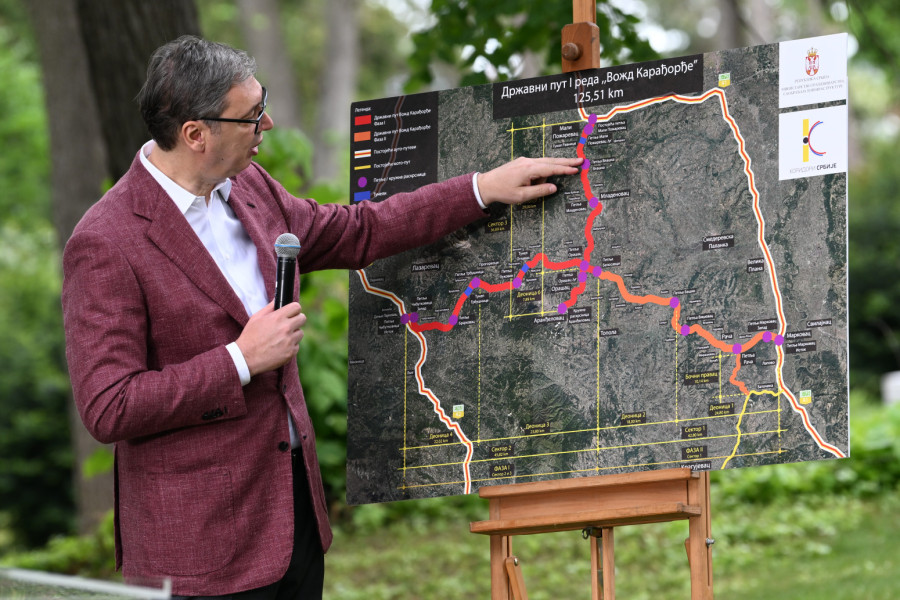
Serbian President Aleksandar Vučić presented the planned route of the Vožd Karađorđe Expressway, explaining how construction will proceed.
“We go from the Belgrade–Niš highway, near Mali Požarevac, turning toward Mladenovac. From Mladenovac toward Orašac, where we have an interchange extended to Aranđelovac. From the other direction, from Čibutkovica, through the Orlovak tunnel, to Orašac. We expect the first section to be completed by 2029, and the second section from the Lazarevac direction by 2030,” Vučić explained.
He also noted that since 2024, Serbia has opened 156 kilometers of highways in one year and four months.
“We will soon open much more, for example 19.5 kilometers from Kuzmin and Rača. At the same time, we are finishing the Danube Corridor to Golubac by the end of the year,” he said.
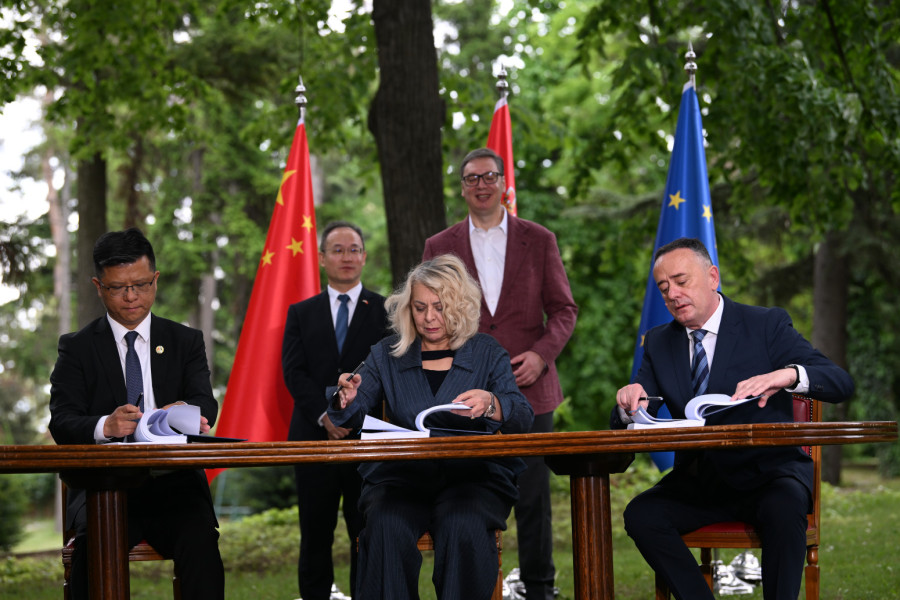
The commercial contract for design and construction, along with the agreement, was signed by Minister of Construction, Transport and Infrastructure Aleksandra Sofronijević, Director of Putevi Srbije Aleksandar Antić, and Director of the Shandong Serbia branch Zhang Xuxian.
“Global economy will grow more slowly than the Serbian economy”
Serbian President Aleksandar Vučić said that Serbia’s projected economic growth for 2026 is currently estimated at 2.8%.
“For 2026, growth of 2.8% is projected, but if we manage to boost the construction sector, we could go above that. Growth could reach even 3%,” Vučić said.
Following the signing of documents for the construction of the Vožd Karađorđe Expressway with the Chinese company Shandong Hi-Speed Group, Vučić stated that initial estimates for the first quarter of this year suggest growth of around 3%, or between 3.0% and 3.1%.
“That is a really good estimate for the first quarter. We fell short in construction, which is why we now need to strengthen both residential and non-residential construction, and especially the issuance of building permits in Belgrade, Novi Sad, Kragujevac, and Niš, in order to maintain growth and aim for around 3%,” he added.
He further said that projections for 2027 indicate that developed countries will grow at around 1.7%, while Serbia could grow at about 3.5%, meaning “twice as fast” as them.
Looking at the region, Vučić said only North Macedonia with 3% and Albania with 3.2% have comparable rates, while others are significantly lower.
“All others have much lower growth rates. The global economy will grow less than the Serbian economy,” he said, adding that if conflicts in Ukraine and the Middle East end in ceasefires, it would ease conditions, though the consequences will remain long-term.
He also estimated that Serbia lost around 120–150 million euros due to the energy crisis, while the European Union formally lost 27 billion euros, with the real cost likely closer to 50 billion euros.
Vučić concluded that Serbia will grow faster next year than all European countries.
“Airlines behave in a market-oriented way when cancelling flights”
Serbian President Aleksandar Vučić commented today on the decision by Croatia Airlines to reduce the number of flights due to high kerosene prices, saying that Air Serbia did not take similar measures, likely because it has stronger financial buffers and is operating somewhat better than the Croatian carrier.
Regarding Croatia Airlines, Vučić said the decision is “normal, rational and market-oriented,” explaining that companies are cutting unprofitable routes due to high fuel costs.
“They will cancel not 900, but 9,000 flights if needed. Why would they let the company collapse while kerosene prices are so high? Their job is to protect their company,” he said, adding that airlines such as Lufthansa, KLM, and Croatia Airlines are acting in line with market logic.
Vučić also said that Serbia is taking measures to protect citizens from fuel price increases, but that the middle and wealthier classes are ultimately the most protected.
“Serbia invests more in infrastructure than Germany”
He stated that Serbia is making large investment efforts, claiming that it is investing more in infrastructure than countries like Germany, France, and Italy, and described the Serbian economy as strong and resilient.
“We allocate 7% to capital investments. No country in Europe does that,” he said, referring also to purchases of military equipment such as Rafale jets, Israeli weapons, and Chinese systems.
Speaking about the construction of the Vožd Karađorđe Expressway, Vučić explained that Chinese company Shandong Hi-Speed Group provided pre-financing of around 300 million euros, stressing that this does not mean Serbia lacks funds but represents a more efficient financial arrangement.
He said Serbia aims to strengthen its financial buffers to better respond to the energy crisis and other global challenges, and announced that further major infrastructure contracts will be signed in the coming period.
Vučić concluded that international institutions such as the IMF recognize Serbia’s economic resilience, describing it as confirmation of the country’s stability and progress.
The ceremony of signing and the address by Serbian President Aleksandar Vučić can be watched in the following video.
0 Komentari
Možda vas zanima

Poznati lanac zatvara 150 prodavnica: U toku su rasprodaje na više lokacija
Diskontni lanac KiK nastavlja da smanjuje broj svojih prodavnica u Nemačkoj. Tokom 2026. godine planirano je zatvaranje oko 150 objekata, dok bi istovremeno trebalo da bude otvoreno svega petnaestak novih.
16:19
11.10.2026.
14 h

Na granicama više ništa nije isto: Svi su strahovali od EES-a, a čeka nas novi sistem
Prošlo je godinu dana od početka uvođenja sistema ulaska i izlaska (EES) na spoljnim granicama Evropske unije, koji je doneo velike promene u načinu kontrole putnika iz zemalja koje nisu članice EU.
17:13
10.10.2026.
1 d

"Pukla stotka" u Pioniru za prvu pobedu Zvezde u ABA ligi, ali brine nova povreda
Košarkaši Crvene zvezde su savladali ekipu Budućnosti u trećem kolu ABA lige rezultatom 101:91 i time upisali porvi trijumf u regionalnom takmičenju u novoj sezoni.
23:25
10.10.2026.
1 d

Rat – dan 1.690: Primirje prekršeno; Rusija udarila na Harkov; Evropi stiglo mračno upozorenje FOTO/VIDEO
Rat u Ukrajini – 1.690. dan. Američki predsednik Donald Tramp objavio energetsko primirje između Rusije i Ukrajine, za koje ukrajinski predsednik kaže da je prekršeno. Na frontu se nastavljaju napadi, a Kijev i Moskva razmenjuju optužbe i upozorenja.
23:50
11.10.2026.
7 h

Vlahović golom protiv bivšeg golmana Partizana ispisuje istoriju
Dušan Vlahović nalazi se pred istorijskim dostignućem u dresu Bešiktaša.
12:52
10.10.2026.
1 d












Komentari 0
Pogledaj komentare Pošalji komentar